
Tuesday, April 21, 2015

Hit the Road in Travels with Charlize

Travels With Charlize
Travels with Charlize

By David R. Gross

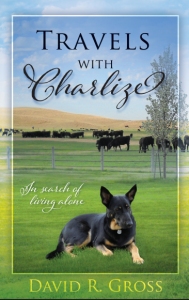
You’ll enjoy traveling with Charlize around the western United States.  Charlize is a lovely German shepherd rescue dog who’s all personality from the tip of her tail to the tip of her wet nose.  The author adopts Charlize after he’s lost the love of his life to cancer, his wife of almost 53 years Rosalie.

The author hit the road on a journey to find what there is left in life for him, seeking what to do with the rest of his years.  He was in search of living alone, supported by man’s best friend at his side.  It’s been said that “the world would be a nicer place if everyone had the ability to love as unconditionally as a dog.”  Charlize is an enthusiastic friend, an excellent listener, great at fetch, and has an innate sense to comfort when it’s needed most.  A reader is reminded of John Steinbeck’s book Travels With Charley.  As John Steinbeck said, “a sad soul can kill you quicker, far quicker, than a germ.”  Travels with Charlize is good medicine for a sad soul.

This book is a compilation of David Gross’ blogs, which makes it such a personal way to unfold his story.  The man and his dog began on their first of several journeys, from Washington State to California at the beginning of the book.  They’re off to visit family and friends towing a camping trailer nicknamed “Frog,” pulled by “Old Blue” a Dodge Ram truck.  That’s certainly a new life for a Veterinarian who also taught and did research in cardiovascular physiology for more than thirty years.

The author’s descriptive passages are entrancing and especially poignant when they include his nostalgic memories.  He compares today’s destinations with his memories of those places during boyhood and as a young man.  As a reader you’ll be surprised when the author reveals what big, visible changes time has brought.  Although their journeys are quite different, there are interesting parallels with John Steinbeck’s book, including each author’s insights into the America they see.  At one point John Steinbeck said, “I wonder why progress looks so much like destruction.”

 Like Steinbeck, our author also finds much beauty to marvel at along the way, and wonderful people.  Charlize turns out to be a natural friend maker and a magnet for attention.  Charlize is also a bit of a daredevil, at one point curiosity leading her onto the verge of unstable cliffs for a better look.  The book is dotted throughout with wonderful pictures of Charlize and of trip highlights.

None of us know what life holds around the corner.  When you have no map, and your GPS isn’t working, you’re fortunate in life if you have a loving, compassionate companion by your side.  This heartwarming tale shows one man’s search to find his way, with his tail wagging friend.

Thereby hangs a tail and a tale . . . .

Monday, April 13, 2015

The Whistling Season Tribute

Whistling Season
The Whistling Season

By Ivan Doig

The first book I ever read by Ivan Doig was The Whistling Season.  This Big Sky author has left behind a lifetime’s work of compassionately written stories about the West and especially Montana for readers to continue to treasure.  A life well lived, and now the sorrow of his passing hits so many.

He’s an icon in the literature of the American West.  But, on his website Ivan Doig repudiated the regional inference: "I don't think of myself as a 'Western' writer. To me, language — the substance on the page, that poetry under the prose — is the ultimate 'region,' the true home, for a writer."  That poetry under prose is one of the unique aspects that frame his stories.  Rhythm, word choice, lyrical intent are the elements of his writing which comes across with a fresh, natural openness.

The Whistling Season is a charming tale of love and loss, truth and lies, and education—conventional and otherwise.  It is, like most of his books, set in rural Montana.  The narrator, Paul Milliron, is looking back almost 50 years, from the vista of 1957, back to when he was a boy.

From an interview with Ivan Doig on this novel he said, “My secret is out, sort of, kind of. Maybe more than any other character or, at least any other narrator who I have ever created, Paul has a few of my mental fingerprints. He loves language, even Latin—which I took in high school. He’s an inveterate reader of books. He eavesdrops with his eyes. He admits to a bit of a pedantic streak. He’s his own person, though.”

The Whistling Season presents Paul Milliron’s passion for isolated public schools that infuse vitality into their communities.  He narrates a loving portrait of this one-room schoolhouse.  In 1957 he’s a man at the end of a career as overseer of Montana schools.  In the era of Sputnik and modernization, he has been charged with announcing the mandated closing of the state's remaining one-room schoolhouses.

The novel’s main plot is straightforward and honest.  In 1909 Oliver Milliron, a recently widowed father of three boys, answers a newspaper ad from a widow in Minneapolis seeking employment: "Can't Cook But Doesn't Bite."   Oliver, a plain man with a love of language can't resist.  When Rose Llewellyn's train arrives, he discovers more than he bargained for; she’s brought her brother Morris.

Rose is feisty, willful and charming.  She takes over housekeeping duties, whistling all the while.  Morris, due to the sudden elopement of the one teacher, is appointed to the post.  Home life, and lessons in the classic one-room schoolhouse, continue but now changed by these spirited eccentrics.

Thereby hangs a tale . . . .

Thursday, March 19, 2015

Advice on the Game of Life from Pete Carroll

k2-_10bdeb50-7712-4b75-a505-187afd7b0693.v1

Treat yourself to the audio book on this one, it’s read by the coach himself.  You’ll experience the full advantages of hearing the charisma and sincerity of an enthusiastic professional coach.  I can see what’s really motivating his players.  Yes, Pete Carroll has developed a very successful coaching philosophy that he’s applied to college and to NFL football teams.  The big surprise is that you can also personalize this philosophy for your life.  “Twelves” and football fans will relish the anecdotes sprinkled throughout the book about specific players who are currently in the NFL.  Football fans will also enjoy learning strategies applied by teams and different coaches.  All readers will appreciate the development of a positive philosophy that they too can apply to their lives.

This book was written when Pete Carroll was on the verge of coaching in Seattle.  Besides a philosophy for self-help, this book is also a memoir.  It includes stories of his childhood and formative years in Northern California, and you can see what has shaped his coaching and how his unique philosophy developed organically from his first hand experience, and from the experience of others.  Big influences were UCLA basketball coach John Wooden, and also Abraham Maslow’s hierarchy of needs.  But in this book you won’t just be learning about it, you’ll have a coach persuading you to buy in.

Winning forever is much more than winning next Sunday’s game. It’s about competing, maximizing your abilities and making the most of the opportunities in front of you, so that each player can become the best he can be, and each team can achieve its fullest potential.  “Of course we want to win every game, but winning forever is more about realizing your potential and making yourself as good as you can be,” says Carroll. “Realizing that is a tremendous accomplishment, whether it’s in football or in life.”  Does that appeal to you personally?  Does that appeal to your family as a team?  Or does it appeal to your group at work?  Or does it appeal to your volunteer organization?  How can you apply this to your life?

Winning forever is about competing to get the most out of every single opportunity – have you ever heard that life is not a dress rehearsal?  This coach is encouraging you to demand of yourself day-in and day-out dedication to achieving your fullest potential.

The coach also has a touching section of the book where he talks about his commitment to giving back to the community.  He encourages giving back what you can.  He describes efforts with youth in Los Angeles to try and get them to see a different vision for their future.  What you see is what you get, and changing the vision along with their hard work will open opportunities.  Pete Carroll does not advocate easy, he advocates hope, giving your best effort, and winning forever.

Thereby hangs a tale . . . .

Saturday, January 31, 2015

A Glimpse Into North Korean Life


The Orphan Master’s Son

By Adam Johnson

This novel is about families living in North Korea under the dictatorship of “the Dear Leader” Kim Jong Il.  At points it’s a brutal story, and there were times I wanted to stop reading, but I just couldn’t put it down.  This novel will move you through a range of emotions as it reveals human nature at extraordinary and at terrifying moments. I think I had to keep reading as I searched for hope.

This author gives a skilled portrayal of his protagonist Jun Do, an everyman citizen of the dangerous Democratic People’s Republic of Korea (DPRK).   The novel’s appeal is how well it reflects the debilitating effects of repression on everyday people.  The author said that he wanted to write about “how the tenets of totalitarianism eat away at the things that make us human: freedom, art, choice, identity, expression, love.”

A primary theme is people struggling to stand and maintain an individual identity against the relentless tide of state propaganda.  This is especially a struggle for Jun Do who is labeled an orphan.  Another theme is how people share loving relationships, when in North Korea your first loyalty and love is demanded to the state.  Priority is rigidly ordered: regime first, family second.  The author asks, “Despite dangers, can lovers share their intimate thoughts” when there is the ominous fear of betrayal to the state.

The novel is in two parts.  The first is the biography of Jun Do, and the second is the confessions of Commander Ga.  It’s a shocking twist how these two parts tie together.  Throughout the book there is a rising tension between America and North Korea.  An interesting progression of seemingly unrelated life events thrust Jun Do unexpectedly into an increasing role on this world stage.

Jun Do’s journey begins as a citizen who does what he’s told, and when he’s told, no matter the ethics, and without question.  His exposure to foreign broadcasts, and life encounters bring him to crossroads that conflict with his society.  The reader gets glimpses into the lives of a variety of characters through Jun Do including: a fishing boat captain, the first mate, a newlywed wife, prison inmates, state propaganda movie actress, army commanders, and the self-censorship and paranoia of an interrogator and his family.  Finally you also meet the Dear Leader himself.

The story is obviously a work of love by the author, who is well qualified to write on the topic.  As he described, “so much research was done to build the story including extensive interviews of Korean orphans, defectors, and revelations of prisoners’ stories.  The Pyongyang’s Workers’ Party newspaper was the source for much of the propaganda that is prominent in the book.”  In 2007 Adam Johnson was allowed by North Korea to take a strictly guided tour of Pyongyang.

I wished for the resilient, inquisitive Jun Do to feel the freedom of his own sense of purpose.  This is fiction, based on extensive research, but as the author said, “the reality is that we’ll know the true way to write a novel set in North Korea when North Korean novelists become free to tell their own stories.  I hope that day comes soon.”

Thereby hangs a tale . . . .

Monday, January 12, 2015

Visit City of Illusions

Judith Works Book Cover jPeg
City of Illusions

By Judith Works

There’s no place like Rome.  With its abundant architectural and artistic riches, Rome celebrates more than 2,500 years of history.  Judith Works’ City of Illusions has given me an exciting taste of contemporary Rome, with its historical backdrop and with its shadows of intrigue.  Et tu Brute?  This novel is an exotic work of fiction that transported me inside a beautiful culture, and a troubled marriage.  Will our heroine excavate love from among Roman ruins?
Rome was not built in a day.  Great things, great places, and great marriages are not achieved without effort and patience.  Something that looks so good on the surface you realize can be deceptive as you delve into its layers.  As the story progresses, Judith skillfully peels back those layers in each of her characters, revealing their motivations and dramas.  From the start, I’m interested in the stormy relationship shown between Laura and her husband Jake.  Just like the characters, I found myself fervently hoping that a change of scene could be arranged, and could be the way to a happily-ever-after.  And Rome is full of surprises.

This author beautifully paints the story, to match the incredible cover art on the book.  I really appreciate how generous Judith is with her description of Rome and the characters’ surroundings.  Along with the famous sites, the reader is treated to a view into the Roman culture that only expats experience.  It includes every day conversations with residents, visits in their homes, and descriptions of the wonderful meals.  That’s right, not just the food, eating is presented as a cultural event.  We also get a taste of the language scattered throughout the book in little phrases and descriptions, which is really fun.  Try reading those out loud.  It’s fascinating following our characters through their daily routines, and even more so following them as they stray from their daily routines.

Judith is the right author to imagine a novel like The City of Illusions.  She interrupted her life in process to temporarily work at the United Nations office in Rome and live there as an expat.  Her love for Rome and Italy shines through every page, and translates into a wonderful stage for this novel of adventure and intrigue.

Thereby hangs a tale . . . .

Sunday, January 4, 2015

2015 Resolution Living a Beautiful Life


Living a Beautiful Life

By Alexandra Stoddard

As I attempt to fulfill my new year’s resolutions, I’ve discovered this book that goes beyond a resolution check list and reminds that living a beautiful life is in the daily details.  Alexandra Stoddard suggests simple ways to easily and inexpensively enhance your quality of life.

The foreword points out that many people save up to 95 percent of their money and effort to spend on 5 percent of their lives during special occasions.  Instead consider that a beautiful life is making the daily 95 percent of your life wonderful.  This can easily be done in so many small ways, if we just make a conscious effort.  Beauty encourages us; it gives us the joy and energy to care more and not to settle for less.  The key is that the beautiful details that you design bring meaning and joy especially for you.

I’m surprised at how little it takes to bring a moment of joy, and how many moments of joy can make up a day.  Beyond reducing clutter that surrounds you and causes stress, this book gives specific examples of easy ways of creating something special out of the ordinary.  You don’t have to be an artist to include artistic touches in your life.  This book spans the areas and time we spend most of our lives: the kitchen, the bedroom, and the bath.  The author also has suggestions about creating a beautiful life with others - family and friends.  Not all the suggestions will speak to you, but many will.  Some of the specifics are outdated; this book’s first edition was in 1986.  It’s surprising how most of the suggestions are timeless though, and the book is filled with so many creative thoughts that it will get you thinking of your own new ideas, that will appeal to you.  There is even space after each chapter for your own notes.

Alexandra Stoddard is a philosopher, author, and interior designer.  She is the author of many books with a similar supportive and encouraging tone offering practical advice, and everyday philosophies on enhancing life. 

Alexandra Stoddard’s unique insights reveal the small but significant things that we can do to change our attitude, heart and environment for the better.  Her books contain a positive personal philosophy of ways to live a beautiful and happy life, laced with grace and wit. She also writes about ritualizing parts of every day, raising public awareness to the importance of little celebrations and ceremonies at home. Her goal is to elevate our daily lives into an art form: we can all live beautifully, moment to moment.

Thereby hangs a tale . . . .

Sunday, December 21, 2014

All I Want For Xmas, Time Travelling Romance


Christmas in the Highlands
By Pam Binder
Miracles blanket Christmas, like a gentle snowfall.  I’ve discovered this special book; it crystallizes what’s behind miracles.  This book displays the author’s belief that time is an illusion, and love is the reality that makes miracles happen.  This is a romantic story, and with an open heart it can make you a believer too.
Irene travels to Scotland on Christmas Eve on a quest.  She deeply misses her mother, who has recently passed away.  But her mother’s death also reveals family secrets that Irene’s curiosity cannot leave at rest.  Her mother’s diary, left for her twin daughters, mysteriously hints at a hidden past, a hidden love, revolving around a specific Scottish castle.  Now it’s Christmas Eve at Stirling Castle; Irene is on the threshold of a holiday tour that will change her life.  Irene is hoping to find some answers.  What she finds are surprises, including meeting a special man who sweeps her off her feet.  But time is an illusion, and Irene and her man will need to find a way back to their own time by midnight or be lost forever.
“When you love someone deeply enough anything is possible.  Even miracles.”  These are the last lines from the 1954 movie Brigadoon, a favorite of Irene’s mother.  Can life imitate the magic of such a story, here in the middle of modern day Scotland?
I really enjoyed the feeling of being magically transported to another time, and to a place that became so real to me.  The interesting characters are infused with a humor that belies much about their backgrounds and character.  The author describes characters a reader readily relates to, and begs the reader to question, what if I was lucky enough to find myself on a time traveling tour full of intrigue . . .
Pam knows history well and weaves the most interesting tidbits into the tapestry of her story.  She is the author of five other books.  Just like this book, her unique stories include a mix of rich romance, fantasy, and time travel.
I recommend you slip a little Christmas in the Highlands into a loved one’s stocking this year.  This magic is most cherished at this time of year, and happily it’s an enchanting story to be re-read in all seasons.
Thereby hangs a tale . . . .